







Today, with the rapid rise in popularity of remote work and changing requirements for work environments, portable containers are becoming an unexpectedly versatile and cost-effective solution. They can be adapted for a variety of purposes: from individual workspaces to corporate offices, changing rooms in construction or industry, and even rest areas for outdoor workers.
In this article, we’ll discuss the potential uses of residential containers, highlighting their advantages:
quick assembly, relatively low cost (especially when buying used ones), and mobility.
I. The Residential Container as a Mobile Workspace
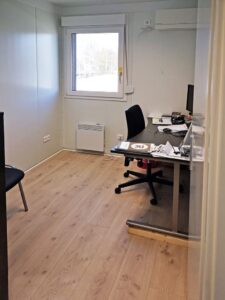
A residential container, also known as an office, modular, or portable container, is ideal as a mobile workspace. Its size and configuration can be easily adapted to individual needs: a single container can be assigned to one employee, while several containers can be connected to form a small office. This is particularly convenient in construction, agriculture, or other fields where employees work outdoors and often have to change their work location.

II. Advantages and Cost Considerations of Utility Containers
Utility containers are becoming increasingly popular in the business world due to their versatility, cost-effectiveness, and quick setup. Their applications are extremely broad, spanning various industries and businesses of all sizes. Below are a few examples of how these containers can be successfully integrated into different areas of operation:
- In the construction sector: changing room containers provide construction workers with a safe and organized space to change, protecting them from adverse weather conditions and ensuring employee comfort. They can also be used as temporary storage spaces for tools and materials, reducing the risk of theft and optimizing the organization of work on the construction site. Containers can also serve as small office spaces for construction managers or engineers, as well as a place to meet with buyers of buildings under construction (such as apartment buildings) and sign contracts.
- In industrial facilities: utility containers can be used as temporary or permanent warehouses, archives, technical rooms, or even small production areas. Their mobility makes it easy to move equipment or goods, while the structural strength of the containers ensures safety. Household containers can be easily customized to meet specific requirements by installing additional lighting, ventilation, or other systems.
- In agriculture: for those working outdoors, utility containers become indispensable tools. They serve as field offices, rest areas for workers, storage for tools and fertilizers, or even as the main workspace for small-scale farming operations, such as selling produce. The mobility of these containers allows them to be strategically placed throughout the farm.
- For small businesses: office containers are an ideal, cost-effective, and quick-to-set-up solution for small businesses that do not need large, permanent offices. They can be customized to meet individual needs, ensuring a functional and comfortable work environment. This is particularly relevant for businesses with a greater need for mobile workspaces, such as retailers or service providers.
Using shipping containers for business saves not only money but also time, as their installation is quick and easy, allowing operations to get up and running faster. It’s worth noting that these structures are an exceptionally eco-friendly choice, as they’re typically made from recycled materials and can be recycled at the end of their useful life.
III. Residential Container for Personal Use
In addition to their use in business, on farms, and in industry, residential containers are a highly popular alternative to garden sheds, offering not only a convenient place to change clothes or store gardening tools but also a comfortable and functional space for overnight stays.
Residential, office, and modular containers are a versatile and cost-effective solution suitable for both personal and business use. The versatility of these structures allows them to be adapted for use in various industries, ensuring a functional space that meets the needs of employees. The affordable price—especially when purchasing used residential containers—makes them even more attractive, as you’ll save both time and money.