







When a “quick storage solution” is needed on a construction site or at a facility, two options are usually considered: a construction trailer (residential/office type) or a shipping container (for storage). From the outside, they look similar, but in reality, they are designed for different purposes, so they differ in price, service life, and operating costs over a 2–5-year period.
The Key Difference: Purpose and Construction
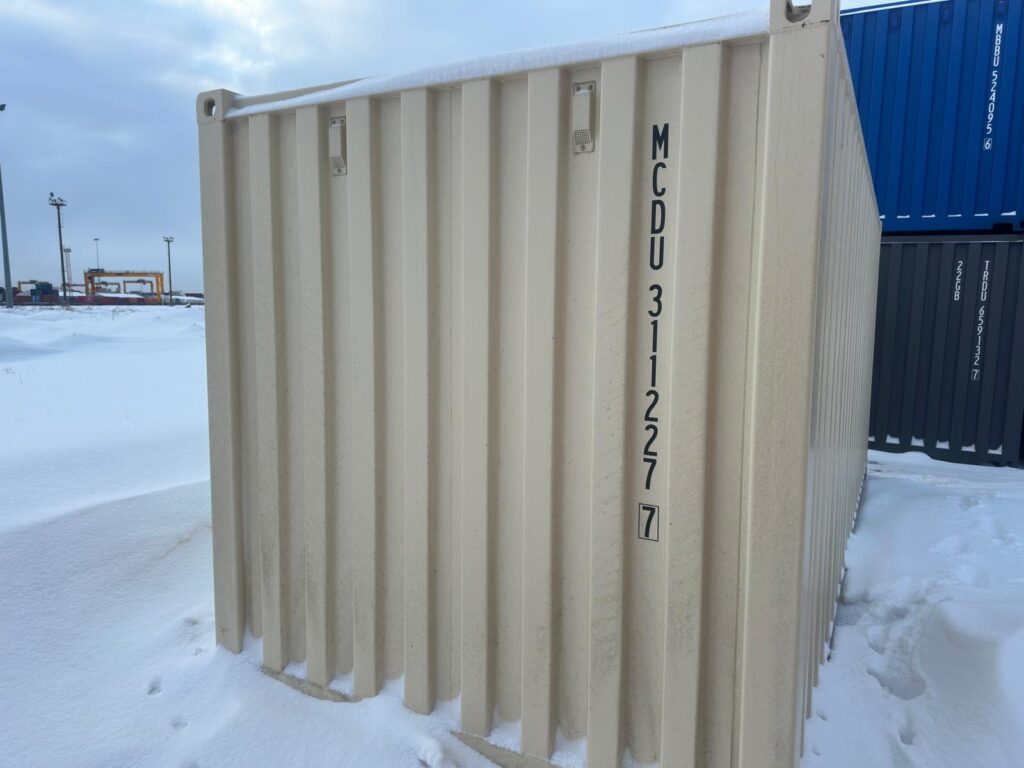
A shipping container is designed to withstand transportation and harsh environments (moisture, impacts, and being stacked on top of one another). It is most often made of Corten (weathering) steel, which is more resistant to corrosion than regular steel.
A construction trailer is more often designed for people and everyday use on-site: to provide heat, windows, electrical wiring, and the convenience of an “office” or changing area. This is not a marine-grade structure, so its outdoor durability depends largely on insulation, weatherproofing, the roof, and maintenance.
Prices in 2026: Why “Cheaper” Often Backfires
At first glance, prices in 2026 seem straightforward. However, in reality, “cheaper” often backfires when you factor in the entire solution, not just the advertised price. Ads in Lithuania show that a used 6-meter shipping container starts at ~€1,200 + VAT (depending on condition and city), while 12-meter containers often start at ~€1,550 + VAT. Construction trailers vary widely in price: from small/used ones at around €580 to fully equipped 3×6-meter models at around €5,500 and up. On the rental market, you can also find household-type trailers for around €130/month.
Quick price guide (text table):
| Solution | Common price in listings (2026) | What typically drives up the price |
| 6-meter shipping container (used) | ~1,200 € + VAT | additional interior fittings, ventilation, lockbox, lighting |
| 12-meter shipping container | ~€1,550 + VAT | Interior customization, security solutions, delivery |
| Construction trailer (purchase) | ~580–5,500 €+ | Level of fit-out, heating, electrical installation |
| Construction trailer (rental) | ~130 €/month | delivery, hookups, rental period |
Most importantly: the purchase price alone doesn’t tell you “how much the solution will cost.” With a shipping container, you’re often paying for customization, while with a trailer, you’re paying for comfort (insulation, windows, electricity). Therefore, compare: purchase/rental + delivery + customization + maintenance.
Durability: Which actually lasts longer?
Durability isn’t just about “how many years an item lasts.” In construction or in the yard, the most important factors are: what load the solution is designed for, how it reacts to moisture, impacts, and temperature fluctuations, and how easy it is to maintain. That’s why a shipping container and a construction trailer often age very differently, even if they look similar.
Shipping container: built for “tough work”
The strength of a shipping container lies in its construction and materials. Most shipping containers are made of Corten (weathering) steel, which forms a protective oxide layer and is more resistant to atmospheric corrosion than regular steel. As a result, even a used container set up “onshore” as a warehouse often lasts a long time—especially if rust spots are periodically treated, the container is repainted, and the seals are replaced.
It is also important to understand the difference between “maritime” and “land-based” use. In logistics, containers are often written off after ~10–13 years of intensive use, but a significant number of them continue to serve successfully on land for decades afterward, provided they are properly maintained. In practice, a service life of 25–30 years or longer is often cited, provided the container is not neglected. This means: the container can withstand impacts from forklifts, frequent opening and closing, and transport on-site, and its “lifespan” depends more on the condition of the roof, the corners, and whether you prevent rust from penetrating into deeper layers.
Construction trailer: durability depends on the structure
The durability of a trailer (residential/office type) depends more on “its construction,” as it typically has more vulnerable areas: seams, panels, insulation, roof seals, and window assemblies. It is often stated in the market that porta/site cabin-type solutions can last approximately 10–25 years or more, depending on the quality of materials, climate, and maintenance.
The greatest risk for a trailer is water ingress. If the seams leak, water penetrates the panels or insulation, accelerating deterioration: this leads to the risk of mold, warping, and “softening” areas. Therefore, it is critical to regularly inspect the roof and joints of the trailer and repair any damage immediately—otherwise, it will begin to age faster than a shipping container, which is a steel structure.
A quick comparison of durability:
True cost: TCO (Total Cost of Ownership) over 24–60 months
To make the comparison “realistic,” calculate it this way:
TCO = purchase (or lease) + delivery + minimal setup + maintenance – residual value (resale). In practice, this means that two solutions with the same purchase price can end up costing very differently over 2–5 years.
What this means in practice:
- A shipping container may be cheaper to buy, but you’ll want a lockable box, ventilation, shelves, and perhaps lighting.
- A trailer is often more expensive, but you get a space ready for people (if needed), not just a warehouse.
When to choose which one?
When choosing between a shipping container and a construction trailer, it’s worth starting with one question: do you need a storage space for items, or a space for people? Both solutions can be located on the same construction site, but they address different needs. A shipping container usually wins out when security, durability, and simple logistics are important. A construction trailer wins out when comfort, warmth, and a “ready-to-use space” for the team from day one are the priorities.
Choose a shipping container if you need a “sturdy” storage unit
A shipping container is the best choice when you want to securely store tools, materials, pallets, or supplies, rather than create a work or rest area for people. It’s especially useful at sites where items need to be locked up every evening and the area is empty on weekends. With a lock box and a good lock, the container becomes a difficult target: thieves need more time and make more noise, so they often look for an easier option.
Another important advantage is its versatility. The container is easy to use as a mini-warehouse next to a workshop, a storage area for materials near a site, or a designated space for a specific work crew. It’s easier to “fit out” with shelves, hooks, racks, ventilation, and lighting, and then move it to another project. If your work is seasonal, a container often becomes a solution that can be considered a long-term asset.
Another advantage is its residual value. Shipping containers typically have a clear secondary market: if the container is watertight and has doors in good condition, it can often be resold as a storage unit. This is especially relevant if the project is temporary and the solution will no longer be needed after 12–24 months.
Choose a construction trailer if you need a comfortable space for people
A construction trailer is usually the best choice when you need space for people: for changing clothes, resting, an office, meetings, or storing documents. If a crew is working long hours, comfort directly impacts productivity: a warm place to change clothes, adequate lighting, windows, the ability to make coffee, or a dry place to store documents. A trailer is usually ready for this right away—with insulation, windows, electrical wiring, and sometimes even heating solutions.
A trailer is also often more convenient if you want a solution “without major modifications.” A shipping container can be adapted, but that still involves additional work and costs. With a trailer, you’re paying for a space that’s already designed for people.
Finally, if renting is a priority, a trailer often makes for an easier start. The rental model allows you to get a solution quickly and, once the project is over, return it without having to find a buyer. This is especially convenient for short-term projects or when you don’t want to “tie up” your budget in a purchase.
A Brief Conclusion
When choosing a solution, it’s important to clearly assess whether your priority is storage or space for people, as well as the planned duration of use (e.g., 6–12 months or 2–5 years). Only then does a comparison of price and durability become practical rather than theoretical.